Which vehicles need an AIS-140 tracker in India?
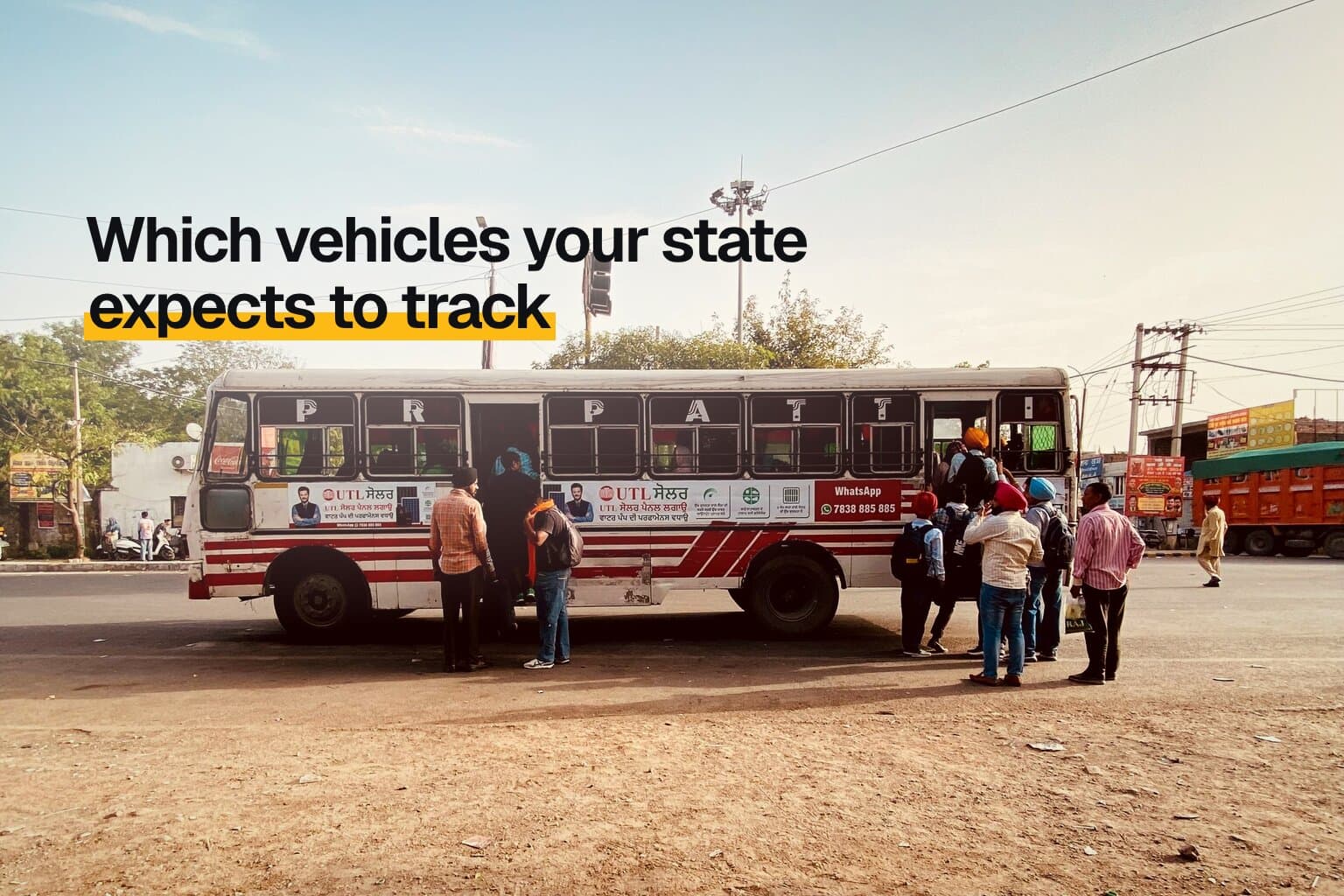
Under Rule 125H of the Central Motor Vehicles Rules, every public service vehicle must carry a vehicle location tracking device (VLTD) and one or more emergency buttons. Two-wheelers, e-rickshaws, three-wheelers and transport vehicles that need no permit are exempt. The device must comply with AIS-140, the Automotive Industry Standard for tracking public transport vehicles.
Public service vehicles are vehicles that carry passengers for hire or reward: buses, school buses, contract and stage carriages, taxis and maxi cabs. National permit goods carriers are also routinely included in state notifications, and a 2022 rule (GSR 617(E)) requires N2 and N3 goods vehicles carrying dangerous or hazardous goods to be fitted with an AIS-140 VLTD, from 1 September 2022 for new models and 1 January 2023 for existing models.
In July 2026 MoRTH also exempted battery electric, ethanol, methanol and hydrogen goods and passenger vehicles from permits for seven years, on the condition that they carry an AIS-140 compliant VLTD. So the list of vehicles that need one is growing, not shrinking.
Is AIS-140 the same in every state?
The device standard is national, but enforcement is not. New public service vehicles registered after 1 January 2019 must be fitted before registration, while each state or union territory decides when older vehicles must be retrofitted, which extra categories it includes, and which empanelled manufacturers can supply devices that connect to its monitoring centre.
That is why a tracker approved by ARAI can still be rejected in your state: it must also be on the state's list of registered manufacturers and send data to the state backend. Always check your state's current notification before buying, not just the ARAI approval.
What do individual states require?
West Bengal implemented its AIS-140 vehicle location tracking system from 1 December 2022. Its SOP sets out how manufacturers, dealers, the State Monitoring Centre and Motor Vehicle Inspectors each complete their part before the RTO approves registration or fitness.
Odisha's State Transport Authority notified VLTD and panic buttons for most public service vehicles (including buses, school buses and taxis), national permit goods carriers, vehicles carrying hazardous or explosive material, and ambulances. New vehicles registered from 1 January 2024 had to be fitted at registration, and existing vehicles by 30 June 2024.
Tripura applies the rule to public service vehicles and national permit goods carriers. Phase I, effective 20 March 2025, covers vehicles registered on or after 1 January 2019, using vendors empanelled with the Transport Department; older passenger vehicles follow in a later phase.
Meghalaya notified a VLTD fitment and tagging SOP in October 2025, with its Monitoring and Control Centre at the Transport Commissioner's office in Shillong and software developed by C-DAC. It also specifies panic button placement: a button for each passenger row plus the driver in cars, buttons along the seating area in buses, and a driver button in national permit trucks.
Tamil Nadu invited manufacturers to empanel in September 2025 for buses, school buses, taxis, maxi cabs and goods carriers including water and petroleum tankers, with devices linked to the state Command and Control Centre and retrofitment centres in every district. Andhra Pradesh separately requires AIS-140 tracking devices on vehicles registered for transporting minerals.
How does AIS-140 activation work?
Activation is a chain, not a single step. The device model must be certified by a testing agency and listed in VAHAN. The manufacturer uploads each unit's IMEI and SIM details, and the dealer links the device to the vehicle in VAHAN and tags it on the state backend with the permit holder's details.
The State Monitoring Centre then confirms the device is sending data in the AIS-140 format, checks the SIM validity and health status, and tests the panic button. Activation details are pushed to VAHAN, a Motor Vehicle Inspector checks the fitment, and only then can the fitment certificate be downloaded so the RTO can approve registration or fitness.
What should a fleet owner check before buying?
Ask for the exact device model and hardware revision, and check it against the latest ARAI list and your state's list of registered manufacturers. Confirm the SIM or connectivity plan validity the state requires, who will tag the device in VAHAN and the state backend, and who books the inspection.
Get the device, installation, connectivity and activation as separate lines in the quote, and keep the fitment certificate with the vehicle's records for fitness renewal. If your fleet runs in more than one state, check each state where vehicles are registered rather than assuming one approval covers all of them.
Frequently asked questions
Is AIS-140 mandatory for all commercial vehicles in India?
Rule 125H makes it mandatory for public service vehicles, except two-wheelers, e-rickshaws, three-wheelers and vehicles that need no permit. Many states also include national permit goods carriers, and goods vehicles carrying hazardous goods must have it under GSR 617(E). Check your state's notification for other categories.
Is AIS-140 required for private cars?
No. The requirement covers transport vehicles used for hire or reward, such as buses, taxis and specified goods carriers. A car registered for personal, non-transport use does not need an AIS-140 tracker.
Why was my ARAI-approved tracker rejected by the RTO?
ARAI approval is only the device-level step. States also require the manufacturer to be registered or empanelled with the state, the device to be tagged in VAHAN and on the state backend, the SIM to be valid, and the panic button and data link to pass the monitoring centre's checks.
Do I need a new AIS-140 tracker for each state my vehicle runs in?
Fitment and activation are tied to the state where the vehicle is registered and its monitoring centre. If your vehicles are registered in different states, check each state's rules and approved manufacturers rather than assuming one approval covers all of them.
Sources and further reading
Rules and dates summarise the official notifications, state SOPs and reports listed under sources, opened on 10 November 2026. State rules change; confirm the current position with your state transport department or RTO before buying or fitting a device.
- Tripura Transport Department: AIS-140 VLTD compliance notice citing GSR 1095(E), S.O. 5453/5454(E), GSR 617(E)
- Government of Arunachal Pradesh: VLTD expression of interest quoting Rule 125H and exemptions
- MoRTH: Standard Operating Procedure for VLT registration and activation in VAHAN (copy hosted by ACMA)
- West Bengal Transport Department: SOPs for VLTD fitment, tagging and activation
- Orissa POST: Odisha mandates VLTD and panic buttons (26 December 2023)
- Gazette of Meghalaya: VLTD fitment and tagging SOP (October 2025)
- DT Next: Tamil Nadu floats EOI to fit trackers on public transport (September 2025)
- Government of Andhra Pradesh (APSAC): AIS-140 tracking devices for mineral transport vehicles
- Autocar Professional: Electric, ethanol and hydrogen CVs get seven-year permit exemption with AIS-140 condition (July 2026)
- MoRTH: AIS-140 standard (PDF)
- SafarTrak: AIS-140 trackers in India (ST100 and ST200)
- SafarTrak blog: AIS-140 tracker model, fit and activation checklist
BRING IT TO YOUR FLEET
Start with your vehicles.
Ask the right questions.
Share your vehicle mix, existing devices and required signals with the SafarTrak team.
See SafarTrak AIS-140 trackersDiscuss your deployment