What is the overloading fee at NH toll plazas?
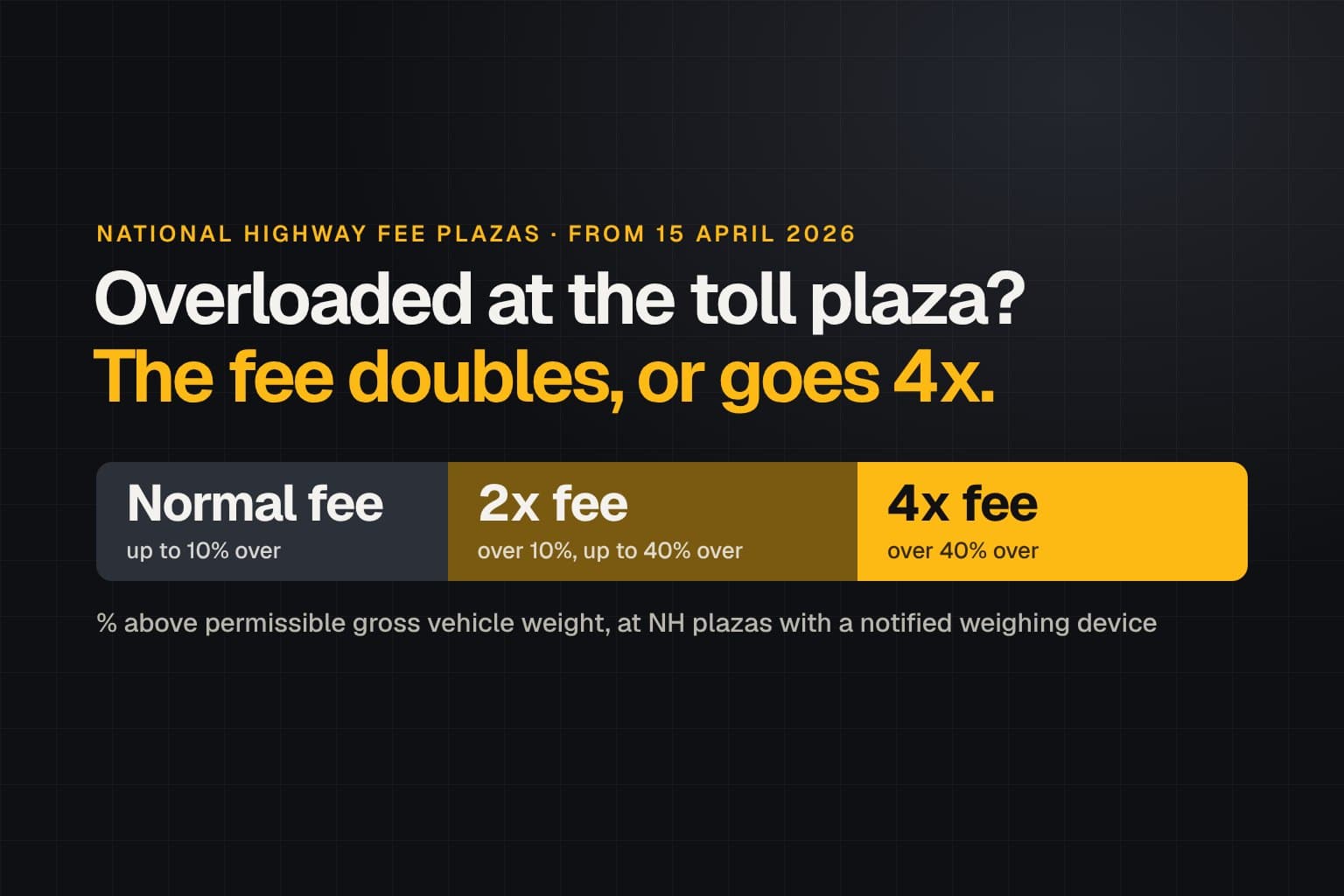
Since 15 April 2026, a vehicle weighed at a National Highway fee plaza and found above its permissible maximum gross vehicle weight pays a higher fee. Up to 10 per cent over, there is no overload fee. Over 10 per cent and up to 40 per cent, the fee is two times the normal fee for that vehicle category. Over 40 per cent, it is four times.
The change comes from a new rule 10 in the National Highways Fee (Determination of Rates and Collection) Rules, 2008, notified as G.S.R. 279(E) on 13 April 2026. The details of the vehicle and the excess load are also reported to VAHAN, the national vehicle register.
How the weight is measured
The rule only works where the plaza has a weight measurement device notified by the Central Government. The device reads the vehicle's total weight, and the excess is what remains after the permissible gross vehicle weight is deducted.
Where no such device is installed at the plaza, no overloading fee is charged and the vehicle pays its normal fee. So the same overloaded truck can pay the normal fee at one plaza and four times the fee at the next, depending on where weighing is in place.
A worked example from the rule
The notification itself uses a three-axle rigid truck with a permissible gross vehicle weight of 28.5 tonnes. Up to 31.35 tonnes (110 per cent) it pays no overload fee. Over 31.35 and up to 39.90 tonnes (140 per cent) the multiplying factor is 2. Over 39.90 tonnes it is 4.
For example, if the normal fee for that category at a plaza were Rs 500, the truck would pay Rs 500 at 31 tonnes, Rs 1,000 at 35 tonnes and Rs 2,000 at 41 tonnes. The Rs 500 figure is an assumption for illustration; plaza fees differ by stretch and category, so use the rate shown for your plaza.
How the fee is paid, and where the rule does not apply
The rule says the fee is collected through digital payment means, including FASTag, UPI or any other electronic means the Central Government notifies. PIB's summary describes collection through FASTag. In practice, most trucks will see it as a larger FASTag deduction at the plaza. A vehicle without a valid, working FASTag falls under the existing rule for that case.
The rule does not apply to private investment projects that were already running before it came in, unless the concessionaire agrees to follow it without asking for compensation. When it started, a MoRTH memorandum of 14 April 2026 held it back in West Bengal, Tamil Nadu, Puducherry, Kerala and Assam until the model code of conduct for those states' elections was withdrawn.
The toll fee is separate from penalties for overloading under the Motor Vehicles Act, which transport and police officers enforce.
What fleet owners should check
Start at loading. Keep the weighbridge slip for every loaded trip and compare it with the permissible gross vehicle weight on the registration certificate. The 10 per cent band is not a target to load to; scales differ, and anything over it doubles the fee at a plaza with weighing.
Then check the FASTag statement against your trips each week. A deduction of two or four times the usual amount at a plaza stands out quickly when you know which vehicle passed which plaza on which trip. GPS trip history gives you that list, with the time each vehicle crossed the plaza, so a higher deduction can be matched to a specific load and loading point.
Because each case is reported to VAHAN, repeated overload records sit against the vehicle, not just the driver. Customers who load your vehicles should know the weight limit and the fee bands.
Frequently asked questions
How much is the overloading fee at toll plazas in India?
On National Highways, from 15 April 2026: no overload fee up to 10 per cent over the permissible gross vehicle weight, two times the normal fee for over 10 and up to 40 per cent, and four times the normal fee above 40 per cent.
Is there a tolerance for overloading at NH toll plazas?
Yes. Up to 10 per cent over the permissible maximum gross vehicle weight, no overload fee is charged. For a three-axle rigid truck with a 28.5 tonne limit, that means up to 31.35 tonnes.
Is the overloading fee charged at every toll plaza?
No. It is charged only where a notified weight measurement device is installed at the fee plaza. Where there is none, the vehicle pays only its normal fee.
Is overloading reported to VAHAN?
Yes. Under the new rule 10, the details of a vehicle found loaded above its permissible gross vehicle weight, with the excess load, are reported to the National Vehicle Register (VAHAN).
Sources and further reading
Rule text from the National Highways Fee (Determination of Rates and Collection) (Fourth Amendment) Rules, 2026, G.S.R. 279(E) dated 13 April 2026, and the MoRTH office memorandum of 14 April 2026, both in the MoRTH PDF linked below, with PIB's release of 14 April 2026; checked on 18 November 2026. This is general information, not legal advice; check the current notification for your case.
- MoRTH: G.S.R. 279(E), 13 April 2026, National Highways Fee (Fourth Amendment) Rules, 2026, with the office memorandum of 14 April 2026
- PIB (14 April 2026): Ministry notifies amendment to streamline fee for overloaded vehicles on National Highways
- SafarTrak: E-way bill and GPS tracking, what transporters must match
- SafarTrak: Fleet KPIs for transport managers in India
- SafarTrak: Fleet tracking for transportation and logistics
Sources checked on . Written and reviewed by Yash Verma, Founder & CEO, SafarTrak. How we write · Suggest a correction
BRING IT TO YOUR FLEET
Start with your vehicles.
Ask the right questions.
Share your vehicle mix, existing devices and required signals with the SafarTrak team.
See SafarTrak for transport fleetsDiscuss your deployment