

What should cold chain exception handling software record?
For each exception, look for the vehicle and sensor identifiers, the approved cargo limits, the measured value and units, and both the measurement and received timestamps. Keep the related trip or stop context and show missing or delayed readings clearly.
An exception needs a response record as well as a notification: who reviewed it, when the approved contact was reached, what action was taken and who authorised the cargo decision. Confirm which of these records the proposed software and sensor setup can provide before rollout.
Start with the cargo requirement
Ask the cargo owner or quality team to define the permitted conditions, handling instructions and response to an excursion. Different products can require different limits and decisions. Do not select a universal temperature range from a tracking website.
Record the source and version of the approved requirement, responsible decision-maker and the shipment groups it applies to. This guide supports operational planning; it does not establish compliance with Indian food, pharmaceutical or transport requirements. Have the relevant quality or regulatory owner confirm those obligations.
Choose and place the sensors
Confirm the sensor’s measurement range, accuracy, calibration arrangements, power and compatibility with the connected device. Discuss placement with the quality team so the reading represents the condition you intend to monitor. A single convenient mounting point may not answer every cargo question.
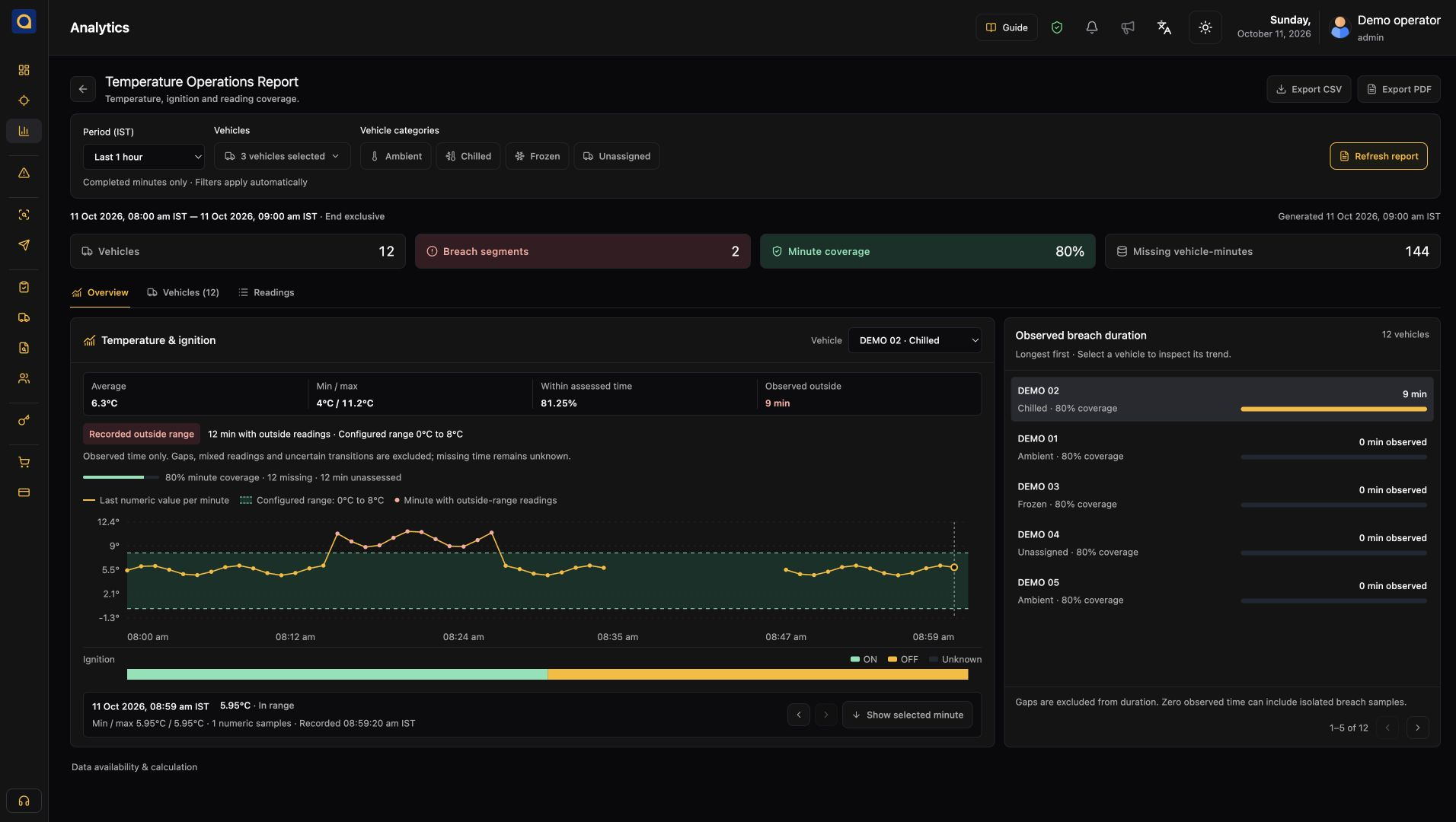
The WHO transport-monitoring reference addresses suitable monitoring equipment and its use in temperature-sensitive pharmaceutical distribution. Use it as background for that context, not as a claim that a SafarTrak setup is certified or suitable for every cargo type.
Test the complete record
Plan a controlled test covering loading, transit, a planned stop and unloading. Record sensor and vehicle identifiers, units, time zone and timestamps. Compare the received readings with the agreed reference process and document any gap or mismatch.
Check what happens when connectivity is lost: whether readings are retained, when they are received and how delayed records are shown. Live visibility and a recoverable historical record address different needs. Agree on the acceptable sampling and reporting behavior for the actual shipment risk.
Make exception response explicit
Agree on the person who reviews an exception, the approved contact path and who has authority to decide what happens to cargo. Test that process with a clearly labelled simulated scenario. A notification without a responsible responder is not a complete workflow.
Record the excursion start and end, available measurements, location context and actions taken. Do not instruct drivers to make cargo-quality decisions beyond their approved responsibility. The quality owner should decide disposition using the applicable product and handling requirements.
Accept the setup and keep it reviewable
Keep a deployment record with sensor placement, calibration information, tested vehicle groups, approved limits, observed gaps and responsible contacts. Define how records will be retrieved and how sensor replacement or configuration changes are documented.
For SafarTrak, confirm the supported sensor, integration, data view and exception workflow before rollout. A map and a temperature reading can provide useful context, but the complete monitoring and response process must be agreed for your shipment. Review the setup when cargo, routes or equipment change.
Put the criteria side by side
Swipe or scroll sideways to view every column.
| Situation | Evidence to record | Response to agree |
|---|---|---|
| Reading outside approved cargo limits | Value, units, vehicle/sensor IDs, limit version and measurement time | Named responder, contact path and quality owner for cargo decisions. |
| Reading arrives late or is missing | Measurement time, received time and the visible data gap | How the team distinguishes delayed reporting from a cargo-condition event. |
| Sensor or equipment changes | Sensor identity, placement, calibration and maintenance record | Who validates the replacement and approves the monitoring setup. |
| Exception is closed | Review time, actions, decision owner and supporting records | How the team retrieves the full record for a later shipment review. |
WORKED EXAMPLE
Testing a temperature alert response
In a simulated excursion, record when the condition was measured, when the platform received it, who reviewed it and when the quality owner was contacted. Compare each step with the response process agreed for the cargo. Use a simulated event; do not deliberately expose a real shipment to unsuitable conditions.
Common questions
What is the difference between temperature monitoring and exception handling?
Monitoring records the available measurements. Exception handling adds the agreed limits, reviewer, contact path, actions and closure record. Verify both the data and the response process with a simulated event before accepting a fleet setup.
Does GPS tracking prove cold-chain compliance?
No. It provides journey context. Cargo requirements, measurement quality, handling, response and records must also be established by the responsible team.
Can one sensor cover every load?
That depends on the cargo, packaging, vehicle and measurement objective. Have the quality team approve placement and coverage for the actual operating setup.
Sources and further reading
- WHO: monitoring temperature during transport
Pharmaceutical transport reference, used for general monitoring principles. Cargo limits and applicable requirements must be set by your quality team.
Written and reviewed by Yash Verma, Founder & CEO, SafarTrak. Sources checked on . How we write · Suggest a correction
Download the review sheet (CSV)