Who the rule covers
FDA's Sanitary Transportation of Human and Animal Food rule, part of the Food Safety Modernization Act (FSMA), applies to shippers, loaders, carriers by motor or rail vehicle, and receivers of food in the US. It has been enforceable since April 2017, and since April 2018 for small businesses. Businesses with less than $500,000 in average annual revenue (inflation-adjusted) are not covered.
A motor carrier that is not also a shipper or receiver counts as a small business if its annual receipts are under $27.5 million.
Temperature: flexible, but you must be able to prove it
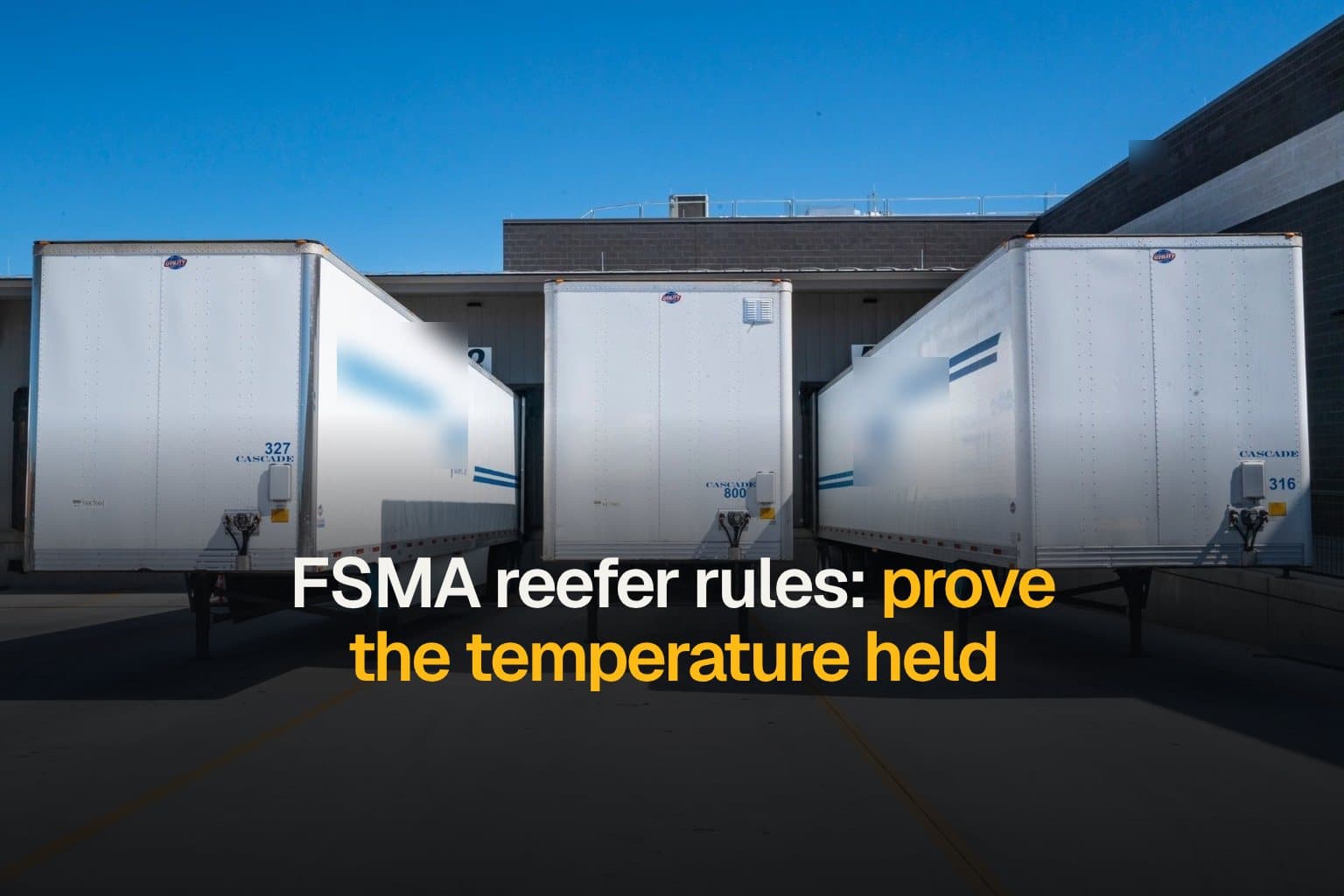
The final rule dropped the requirement for a specific temperature recording device. Instead, the shipper and carrier can agree on how temperature is monitored for food that needs temperature control for safety.
But the carrier still has duties. Before offering a vehicle with a refrigeration unit, it must pre-cool each compartment as the shipper specifies. If the receiver asks after delivery, the carrier must give the operating temperature the shipper specified, and if the shipper or receiver asks, the carrier must show temperature conditions were maintained, for example with ambient readings at loading and unloading or time and temperature data from the trip.
Records and training
Carriers that take on sanitary responsibilities under an agreement must train staff on food safety hazards in transit, basic sanitary practices and their duties under the rule, and keep records of the date, type of training and who was trained. Training records are kept for 12 months after the person stops doing those duties; written procedures and agreements are kept for 12 months after they stop being used.
Making temperature proof automatic
Paper logs and spot readings are easy to dispute. A reefer temperature sensor linked to GPS tracking records time, temperature and location for the whole trip, plus door openings, so you can answer a shipper's or receiver's request with a trip report instead of a phone call. Alerts for out-of-range temperature let a dispatcher act before a load is rejected.
Agree the monitoring method and the report format with each shipper in writing, and store trip reports for at least as long as your agreements require.
Frequently asked questions
Does FSMA require a temperature recorder in reefer trucks?
No specific device is required. The shipper and carrier can agree on a monitoring method, but the carrier must show temperature was maintained if the shipper or receiver asks.
Must carriers pre-cool reefers under FSMA?
Yes. Before offering a vehicle with an auxiliary refrigeration unit, the carrier must pre-cool each compartment as the shipper specifies.
How long must FSMA transport records be kept?
Training records for 12 months after the person stops those duties, and written procedures and agreements for 12 months after they stop being used.
Which businesses are exempt from the Sanitary Transportation rule?
Businesses with less than $500,000 in average annual revenue, adjusted for inflation, plus some activities such as transporting fully enclosed shelf-stable food.
Sources and further reading
Based on FDA's final rule on Sanitary Transportation of Human and Animal Food (81 FR 20091, 6 April 2016), FDA's Small Entity Compliance Guide and FDA's Key Changes page. This is general information, not legal advice.
- FDA: Key changes in the FSMA final rule on Sanitary Transportation
- FDA: Sanitary Transportation Small Entity Compliance Guide
- Federal Register: Sanitary Transportation of Human and Animal Food final rule (6 April 2016)
- SafarTrak: GPS fleet tracking cost for small businesses
Sources checked on . Written and reviewed by Yash Verma, Founder & CEO, SafarTrak. How we write · Suggest a correction
BRING IT TO YOUR FLEET
Start with your vehicles.
Ask the right questions.
Share your vehicle mix, existing devices and required signals with the SafarTrak team.
See SafarTrak cold-chain monitoringDiscuss your deployment