Which vehicles do Kenya's commercial vehicle regulations cover?
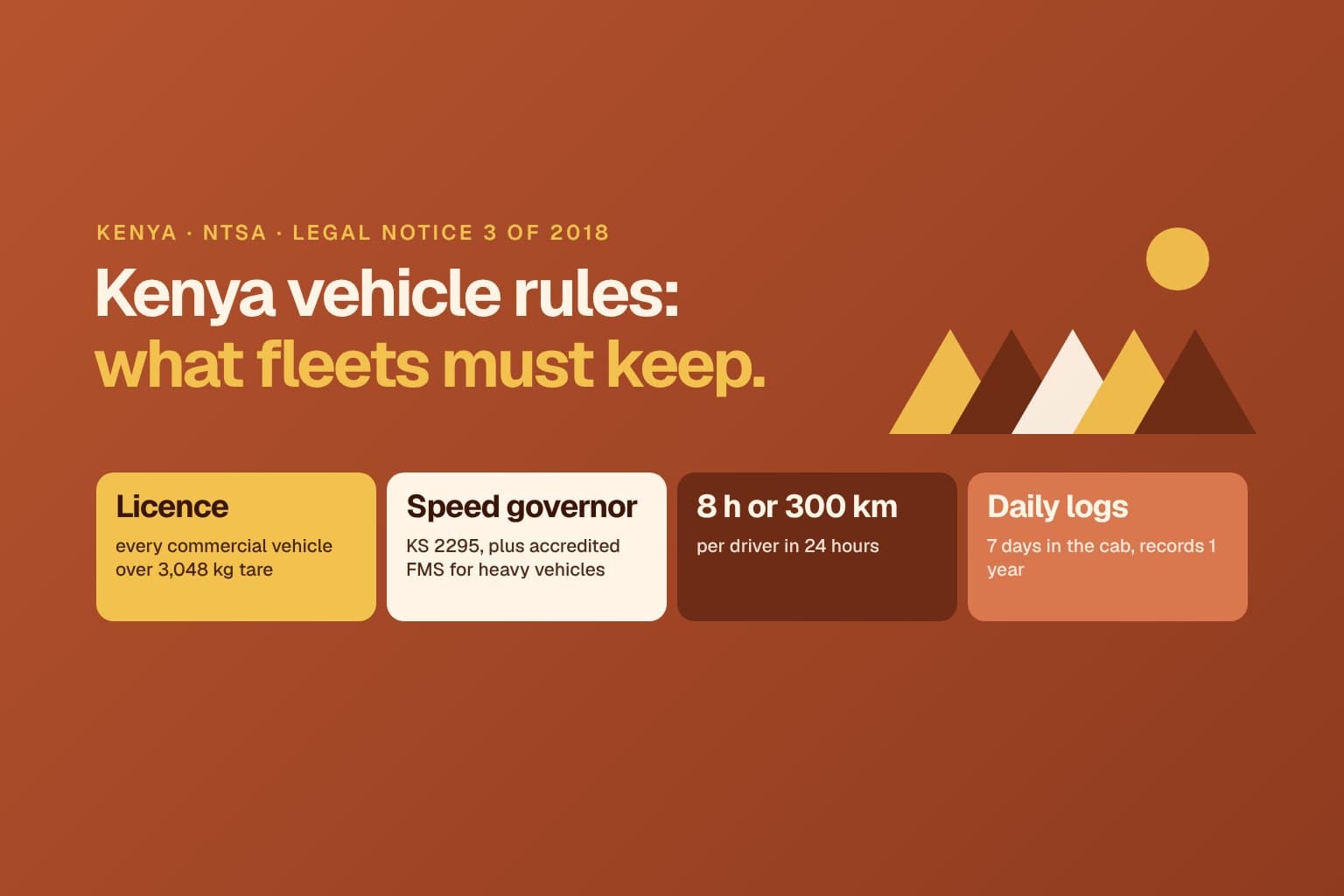
The National Transport and Safety Authority (Operation of Commercial Vehicles) Regulations, 2018 apply to any commercial vehicle with a tare weight of more than 3,048 kg operating on a public road in Kenya. Tare is the empty weight of the vehicle, not the loaded weight.
A carrier or driver may not operate such a vehicle without a valid commercial vehicle licence from NTSA. The licence runs for one year and is renewed annually; the regulations set the fee at KSh 2,000 per vehicle to apply and KSh 1,500 to renew.
What the licence application needs
Along with the roadworthiness certificate and insurance, the application must show that a speed governor is fitted. For heavy commercial vehicles it must also show that a fleet management system accredited by NTSA is installed. NTSA decides on an application within 14 days.
Every commercial vehicle must have a speed governor conforming to Kenyan Standard KS 2295, or one approved by the Authority, and retro-reflective contour markings conforming to KS 1820.
Driving hours and rest
A driver may not drive once they have accumulated eight hours of driving, or 300 km, within 24 hours, whichever comes first. Where a trip will go beyond 500 km or eight hours, the vehicle needs two drivers.
Drivers must rest for at least one hour for every four hours of continuous driving.
Daily logs, records and reporting
Drivers of heavy commercial vehicles complete a daily log sheet, and the carrier must make sure the previous day's log is done before the driver sets off. The driver keeps the last seven days of logs in the vehicle.
Carriers keep a maintenance record, the inspection report and a monthly record of the daily logs for at least one year, in paper or electronic form. A crash that causes a death must be reported to NTSA within 24 hours, and each quarter the carrier submits its list of authorised drivers and copies of the monthly log sheets.
Breaking the regulations is an offence carrying a fine of up to KSh 20,000, up to six months in prison, or both, and NTSA can suspend or revoke the vehicle's licence.
How tracking data helps with compliance
Most of these rules depend on records: hours driven, distance per day, rest stops and maintenance. GPS trip history gives driving time and km per vehicle per day, so a dispatcher can see a driver approaching eight hours or 300 km before the limit is crossed, and plan the second driver for long trips.
Exported trip reports can sit beside the paper or electronic logs NTSA asks for, and service records kept against each vehicle make the one-year maintenance record easier to produce at an inspection or safety audit.
What may change
In January 2025, Kenyan media reported draft Commercial Service Vehicles regulations covering telematics, fire extinguishers, first aid kits and underrun protection. The reports described them as a draft awaiting approval, so check NTSA for their current status before planning around them.
Frequently asked questions
Which vehicles need an NTSA commercial vehicle licence in Kenya?
Under the 2018 regulations, commercial vehicles with a tare weight above 3,048 kg operating on public roads. The licence is valid for one year and renewed annually.
How many hours can a commercial driver drive in Kenya?
Up to eight hours or 300 km in 24 hours, whichever comes first, with at least one hour of rest for every four hours of continuous driving. Trips over 500 km or eight hours need two drivers.
Do commercial vehicles in Kenya need a speed governor?
Yes. All commercial vehicles covered by the regulations must have a speed governor conforming to KS 2295 or approved by NTSA, and evidence of it is needed for the licence.
Do heavy commercial vehicles in Kenya need a fleet management system?
The licence application for a heavy commercial vehicle must include evidence of a fleet management system accredited by NTSA.
Sources and further reading
Rules summarised from the National Transport and Safety Authority (Operation of Commercial Vehicles) Regulations, Legal Notice 3 of 2018, as published on Kenya Law (version revised to 31 December 2022), checked on 18 November 2026. Reports from January 2025 describe draft Commercial Service Vehicles regulations; their legal status was not confirmed, so they are not treated as law here. This is general information, not legal advice.
- Kenya Law: NTSA (Operation of Commercial Vehicles) Regulations, Legal Notice 3 of 2018
- The Star (27 January 2025): NTSA issues safety regulations for commercial service vehicles (draft)
- SafarTrak: Fleet tracking for transportation and logistics
Sources checked on . Written and reviewed by Yash Verma, Founder & CEO, SafarTrak. How we write · Suggest a correction
BRING IT TO YOUR FLEET
Start with your vehicles.
Ask the right questions.
Share your vehicle mix, existing devices and required signals with the SafarTrak team.
See how SafarTrak tracks a fleetDiscuss your deployment