Speed limitation devices: 90 km/h
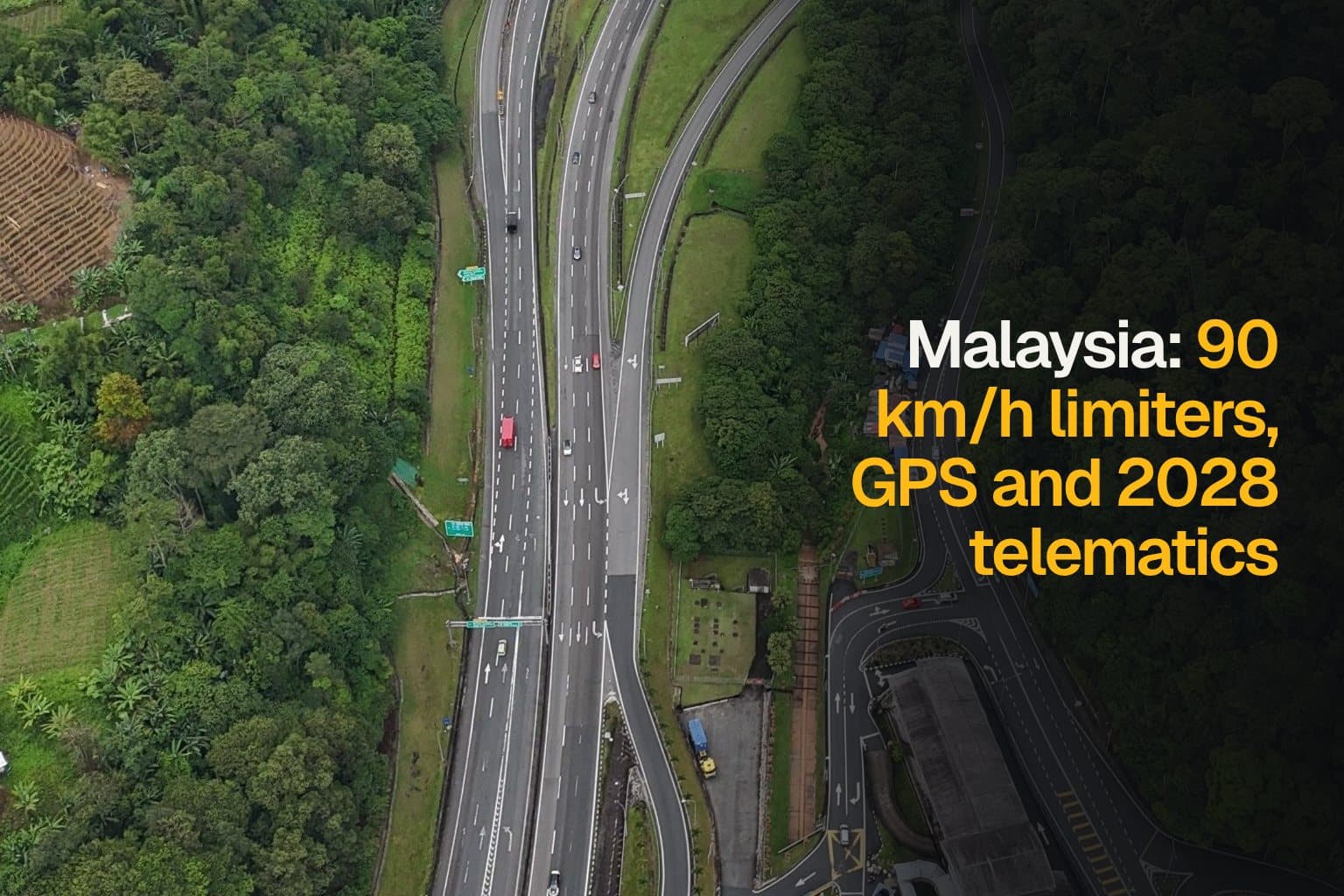
Malaysia requires speed limitation devices (SLD) set to 90 km/h on express and tour buses, goods vehicles over 3,500 kg maximum permissible weight, and passenger vehicles carrying more than eight people and weighing over 5,000 kg. The cap applies even where the road limit is higher, such as 110 km/h on expressways.
Enforcement came in phases. From 1 October 2025, JPJ checked vehicles registered from 2015 onwards. From 1 January 2026, owners of vehicles registered before 2015 had to activate the SLD function already in the vehicle's ECU; this also covers rebuilt vehicles and used imported goods vehicles over 3,500 kg. Vehicles without any SLD were to fit a JPJ-approved retrofit device from 1 July 2026, but JPJ postponed that phase in September 2026, with a new date still to be announced.
How far compliance has got
Uptake has been slow. The transport minister said that as of 14 January 2026, 63,127 of 513,679 commercial vehicles, about 12%, had installed an SLD. JPJ had issued more than 4,200 verification notices in the first weeks of enforcement, with no summons if owners complied within the set period.
GPS on commercial vehicles
Commercial vehicles under regulated permits must carry working GPS tracking: APAD oversees this in Peninsular Malaysia and LPKP in Sabah and Sarawak. In 2025 JPJ's special safety audit found 85 of 133 audited transport companies failing mandatory safety requirements, including missing GPS and not monitoring driver hours, and road safety experts called for permits to be revoked for dummy GPS devices.
The ministry has said it will integrate GPS with JPJ's systems to monitor commercial vehicle violations. Dashcams for buses and lorries have also been proposed.
Telematics from 2026 to 2028
The government plans to phase in telematics for commercial vehicles: a voluntary and advocacy phase in 2026 and 2027, then a commercial vehicle driver database and centralised telematics data, with telematics proposed as a mandatory licensing requirement from 2028, subject to industry readiness. A proof of concept ran from September to December 2025.
For operators, the practical step now is a tracking setup that logs speed, location and driver hours reliably, so the same data can serve APAD permits, JPJ audits and later telematics requirements.
Frequently asked questions
Which vehicles need a speed limiter in Malaysia?
Express and tour buses, goods vehicles over 3,500 kg maximum permissible weight, and passenger vehicles carrying more than eight people and weighing over 5,000 kg. The device caps speed at 90 km/h.
When must older vehicles fit a retrofit speed limiter?
The retrofit phase was due on 1 July 2026 but JPJ postponed it in September 2026. A new date is to be announced.
Is GPS mandatory for commercial vehicles in Malaysia?
Yes for commercial vehicles under regulated permits, overseen by APAD in Peninsular Malaysia and LPKP in Sabah and Sarawak.
Will telematics become mandatory in Malaysia?
The government proposes considering telematics as a mandatory licensing requirement from 2028, after voluntary adoption in 2026 and 2027.
Sources and further reading
Based on Ministry of Transport and JPJ statements reported by Bernama, Malay Mail, Paul Tan, The Star, The Edge and The Sun between June 2025 and October 2026. Dates have moved; check JPJ and APAD for current enforcement dates.
- Bernama: Mandatory enforcement of SLD for commercial vehicles starts Oct 1 (June 2025)
- Malay Mail: JPJ to enforce speed limiter checks from Oct 1 (June 2025)
- Paul Tan: over 4,200 speed limiter verification notices issued
- Bernama: Govt plans integrated data system to monitor heavy vehicle drivers (February 2026)
- The Star: JPJ postpones retrofit speed limiter enforcement (September 2026)
- Malay Mail: JPJ audit finds 85 of 133 transport companies failing safety requirements (2025)
- Bernama: MOT to integrate GPS and JISA systems (October 2025)
- The Edge: Telematics for commercial vehicles phased from 2026
Sources checked on . Written and reviewed by Yash Verma, Founder & CEO, SafarTrak. How we write · Suggest a correction
BRING IT TO YOUR FLEET
Start with your vehicles.
Ask the right questions.
Share your vehicle mix, existing devices and required signals with the SafarTrak team.
See how SafarTrak tracks a fleetDiscuss your deployment