What changed for trucks in Dubai on 1 October 2026?
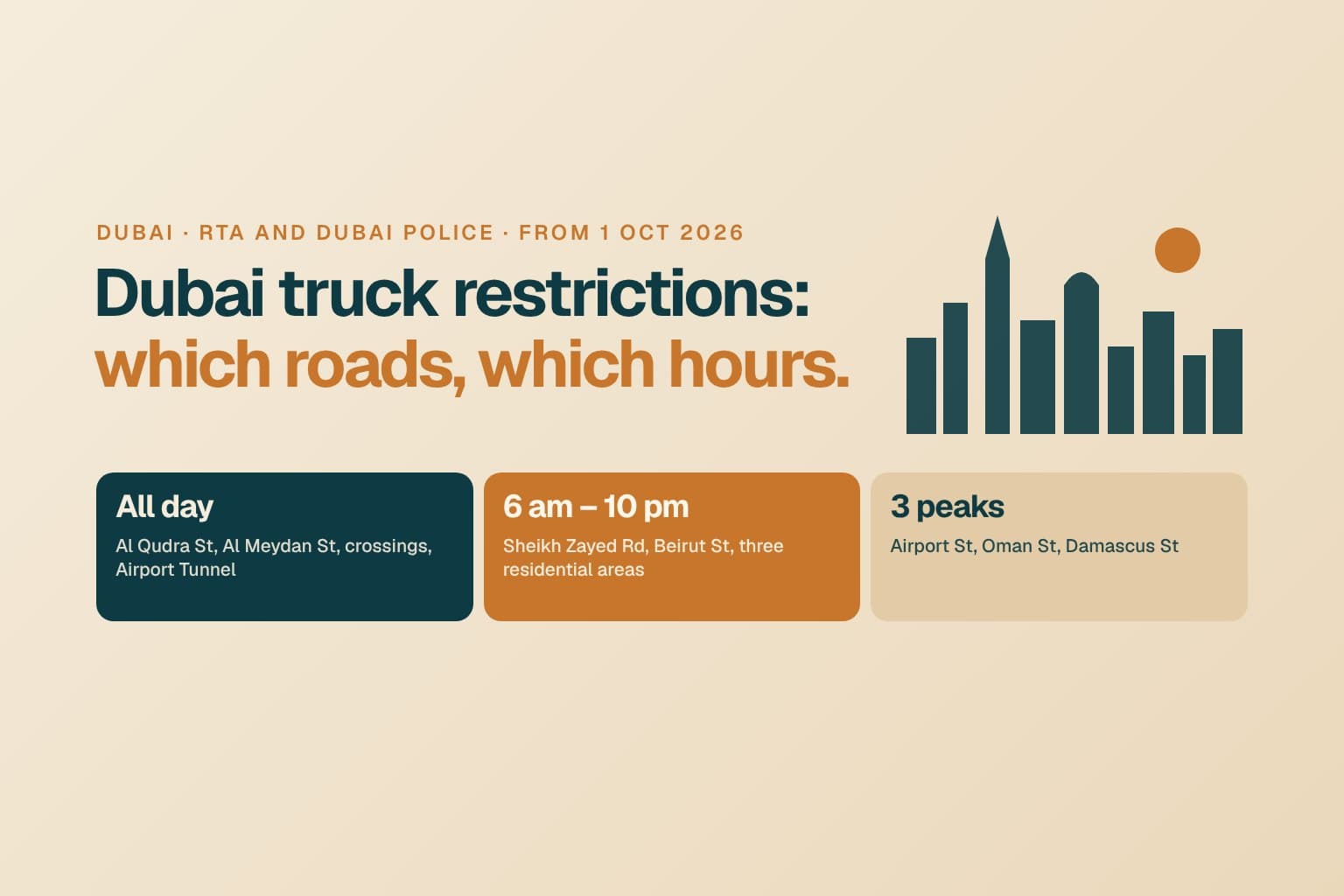
From 1 October 2026, RTA and Dubai Police restrict truck movement on roads across the Emirate of Dubai at set times. There are three levels: roads closed to trucks round the clock, roads closed from 6:00 am to 10:00 pm, and roads closed only during three daily peak periods. Emirates Road is exempt.
For a fleet, this changes dispatch times, routes and how long a delivery takes, so the timetable needs to be built into trip planning rather than left to each driver.
Roads closed to trucks round the clock
Al Qudra Street, Al Meydan Street, all crossings and the Airport Tunnel are closed to trucks at all times under the new restrictions.
Roads closed from 6 am to 10 pm
Sheikh Zayed Road and Beirut Street, and the residential areas of Al Mizhar, Muhaisnah and Oud Al Muteena, are closed to trucks for 16 hours a day, from 6:00 am to 10:00 pm. Trucks that need these roads have the overnight window from 10:00 pm to 6:00 am.
Roads closed at three peak periods
Airport Street, Oman Street and Damascus Street are closed to trucks during three daily peaks: 6:30 to 8:30 am, 1:00 to 3:00 pm and 5:30 to 8:00 pm. Outside those windows, trucks can use them.
RTA's announcement refers to trucks and heavy vehicles but does not set a weight threshold, so check with RTA if you are unsure whether a vehicle class is covered.
Permits for essential trips
Companies whose operations need trucks to move during restricted hours, in essential cases only, apply through RTA's website for the Mobility Permit for Heavy Vehicles in Banned Times and Roads, handled by RTA's Right-of-Way (ROW) Department.
RTA also reported that 14 of 16 planned truck rest stops are complete, with 364 spaces added at seven stops for a total of 1,007, so drivers have somewhere to wait out a restricted period.
How fleets can plan around the restrictions
Draw the restricted roads and areas as zones in your tracking system and attach the hours to each one. A truck entering Sheikh Zayed Road at 7:00 am, or the Airport Tunnel at any time, then raises an alert to the dispatcher before it becomes a problem on the road.
Review trip history weekly for the same zones: it shows which routes and loading points keep pushing trucks into peak windows, and where moving a pickup by 30 minutes or switching to Emirates Road would avoid them. Keep the permit reference with each trip that needs one, so the record shows why that truck was on a restricted road.
Frequently asked questions
What are the truck ban timings in Dubai?
From 1 October 2026: round the clock on Al Qudra Street, Al Meydan Street, all crossings and the Airport Tunnel; 6:00 am to 10:00 pm on Sheikh Zayed Road, Beirut Street and in Al Mizhar, Muhaisnah and Oud Al Muteena; and 6:30 to 8:30 am, 1:00 to 3:00 pm and 5:30 to 8:00 pm on Airport Street, Oman Street and Damascus Street.
Can trucks use Sheikh Zayed Road in Dubai?
Only from 10:00 pm to 6:00 am. Sheikh Zayed Road is closed to trucks from 6:00 am to 10:00 pm under the restrictions that started on 1 October 2026.
Is Emirates Road included in Dubai's truck restrictions?
No. RTA's announcement exempts Emirates Road from the truck movement restrictions.
How do I get a permit to move a truck during banned hours in Dubai?
For essential cases only, apply on RTA's website for the Mobility Permit for Heavy Vehicles in Banned Times and Roads, through RTA's Right-of-Way (ROW) Department.
Sources and further reading
Roads, hours, exemption and permit route from RTA's announcement of 26 September 2026, issued with Dubai Police, checked on 18 November 2026. Fines and penalties are not covered here; check RTA and Dubai Police for current amounts. Abu Dhabi and Sharjah set their own truck restrictions.
- RTA (26 September 2026): Truck movement restrictions during peak periods on Dubai roads from 1 October 2026
- RTA (15 July 2026): Joint campaign with Dubai Police to raise traffic awareness for truck drivers and transport companies
- SafarTrak: Fleet tracking for transportation and logistics
Sources checked on . Written and reviewed by Yash Verma, Founder & CEO, SafarTrak. How we write · Suggest a correction
BRING IT TO YOUR FLEET
Start with your vehicles.
Ask the right questions.
Share your vehicle mix, existing devices and required signals with the SafarTrak team.
Where SafarTrak worksDiscuss your deployment