Who needs an ELD?
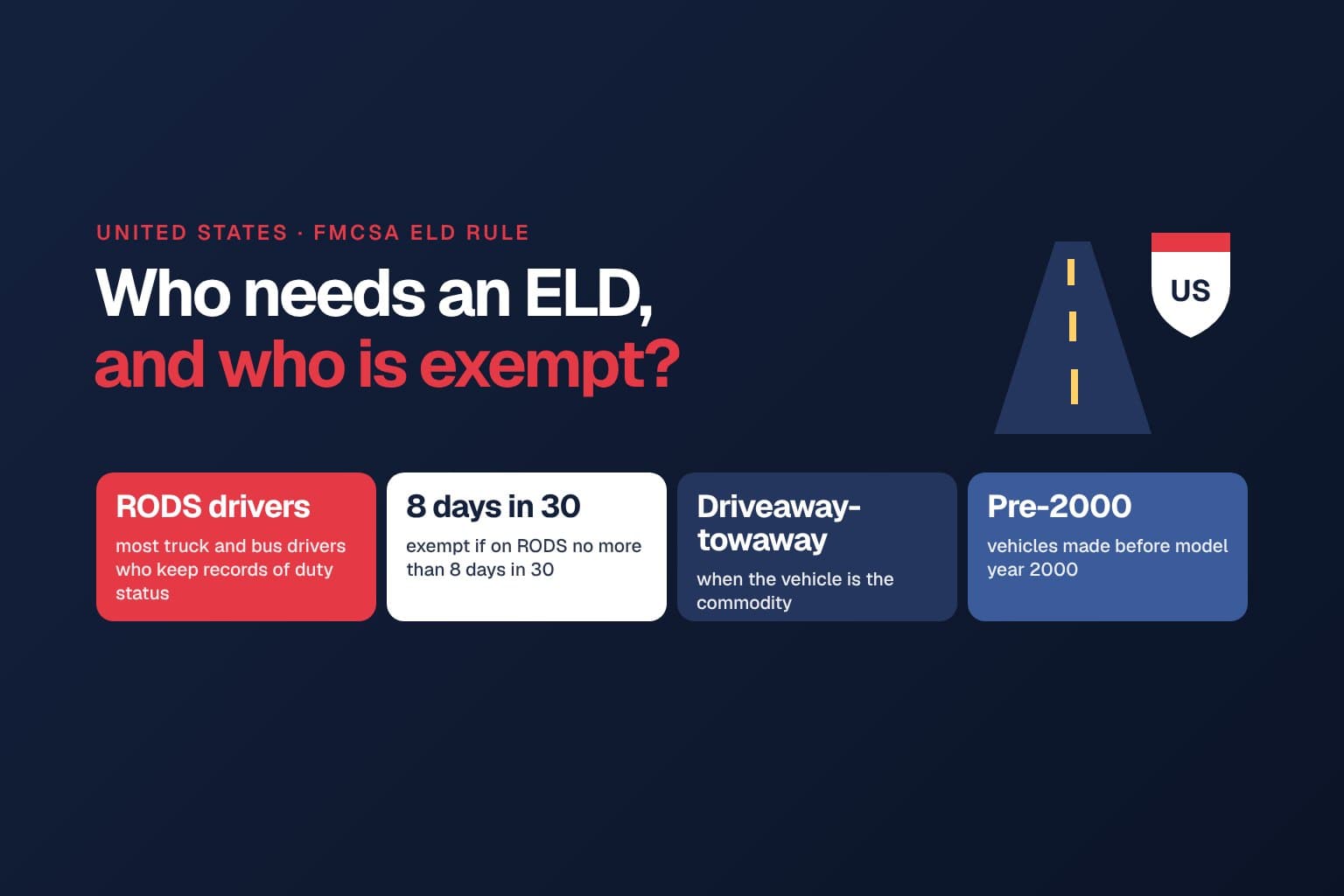
FMCSA's ELD rule applies to most motor carriers and drivers who are required to keep records of duty status (RODS). It covers buses as well as trucks, and includes Canada- and Mexico-domiciled drivers unless they qualify for an exception.
An ELD connects to the vehicle's engine to record driving time automatically. The rule did not change the hours-of-service limits themselves; it changed how duty status is recorded.
The exemptions FMCSA lists
Drivers who keep RODS for no more than 8 days in any 30-day period. Driveaway-towaway drivers, where the vehicle being driven is the commodity being delivered. Drivers of vehicles manufactured before model year 2000.
Drivers who are not required to keep RODS at all are outside the rule, which is why many local and short-haul operations do not use ELDs. Whether a driver qualifies depends on the hours-of-service exceptions in 49 CFR 395.1, so check the exact conditions before relying on one.
Use a registered device
ELD providers self-certify their devices and register them with FMCSA. FMCSA tells carriers to check that the model they buy is on its list of registered ELDs, because a carrier using a device not on the list can be cited for violating the rule.
When an ELD malfunctions, the rule gives carriers a limited time to repair or replace it, with paper logs in the meantime; check FMCSA's guidance for the current time limit and steps, and request an extension through FMCSA if you need one.
ELD data and GPS fleet tracking
An ELD answers one question for inspectors: has the driver stayed within hours of service. GPS fleet tracking answers the operational ones: where the vehicle is now, how long it waited at a shipper, and which route it took.
Many fleets run both from one telematics device. If you do, check that the ELD function is the registered model, and use trip and stop data to plan loads that keep drivers inside their hours rather than discovering the problem at the end of a shift.
Frequently asked questions
Who is exempt from the ELD mandate?
FMCSA lists drivers who keep RODS no more than 8 days in any 30-day period, driveaway-towaway drivers where the vehicle is the commodity, and drivers of vehicles manufactured before model year 2000. Drivers not required to keep RODS are outside the rule.
Does the ELD rule apply to buses?
Yes. FMCSA says the rule applies to commercial buses as well as trucks for drivers required to keep records of duty status.
How do I know an ELD is compliant?
Check that the exact model is on FMCSA's list of registered, self-certified ELDs. Using a device not on the list can lead to a citation.
Sources and further reading
Rule scope, exemptions and the registered-device requirement from FMCSA's ELD pages, checked on 18 November 2026. This is general information, not legal advice; check 49 CFR Part 395 and FMCSA guidance for your operation.
- FMCSA: Electronic Logging Devices
- FMCSA: ELD exemptions and waivers
- FMCSA: ELD information for drivers and motor carriers
- FMCSA: List of registered ELDs
Sources checked on . Written and reviewed by Yash Verma, Founder & CEO, SafarTrak. How we write · Suggest a correction
BRING IT TO YOUR FLEET
Start with your vehicles.
Ask the right questions.
Share your vehicle mix, existing devices and required signals with the SafarTrak team.
See how SafarTrak tracks a fleetDiscuss your deployment